Last week, news broke that James Dean will star in a new movie-64 years after his death. A production company called Magic City got the rights to Dean’s image from the late actor’s estate and plans to bring him to the silver screen again thanks to the wonder (or terror) of CGI. Now, Dean, or the digitally resurrected version of Dean or whatever, will play the second lead in a Vietnam War movie called Finding Jack, with a living actor standing in as his voice.
Unsurprisingly, the announcement inspired a wave of immediate backlash around Hollywood.
Chris Evans called it “awful” and “shameful,” and Elijah Wood said, simply, “NOPE.” But it turns out the intense reaction was surprising to at least one person: Magic City’s Anton Ernst, the Finding Jack director.
Ernst told the Hollywood Reporter in a new interview that he’s gotten “positive feedback” about the movie and that the Dean estate has been “supportive,” saying it will inspire “a whole new generation of filmgoers to be aware of James Dean.” He didn’t see the overwhelming negativity coming. Per the Reporter:
Ernst spoke with The Hollywood Reporter about the criticisms on social media, saying he was “saddened” and “confused” over the overwhelmingly negative comments. “We don’t really understand it. We never intended for this to be a marketing gimmick,” he said.
He also brought up Carrie Fisher’s appearance in the new Star Wars as an example of a way this posthumous CGI work can be done well, apparently missing the difference between honoring Fisher’s legacy in a role she was already scheduled to play and plopping James Dean in some random war movie half a century after his death.
When discussing whether resurrecting Dean digitally crosses a line with regards to posthumous casting, Ernst explained, “Anyone that is brought back to life – you have to respect them.” He noted Fisher’s posthumous appearances in the Star Wars franchise, saying that if the actress had expressed never wanting to be in a film after her death, or if her legacy or that of the franchise could be “tarnished” because of her casting, “then that should be a line.”
“I think the line should be … you must always honor the deceased’s wishes and try to act in a way that is honorable and full of dignity,” Ernst said.
Again, this is extremely different, since Dean could never have stated he didn’t want to appear in a film after his death because, uh, how would he have imagined that was even a possibility-but whatever. Finding Jack is still headed into production with an expected release on November 11, 2020, whether we like it or not.
Last week, news broke that James Dean will star in a new movie-64 years after his death. A production company called Magic City got the rights to Dean’s image from the late actor’s estate and plans to bring him to the silver screen again thanks to the wonder (or terror) of CGI. Now, Dean, or the digitally resurrected version of Dean or whatever, will play the second lead in a Vietnam War movie called Finding Jack, with a living actor standing in as his voice.
Unsurprisingly, the announcement inspired a wave of immediate backlash around Hollywood.
Chris Evans called it “awful” and “shameful,” and Elijah Wood said, simply, “NOPE.” But it turns out the intense reaction was surprising to at least one person: Magic City’s Anton Ernst, the Finding Jack director.
Ernst told the Hollywood Reporter in a new interview that he’s gotten “positive feedback” about the movie and that the Dean estate has been “supportive,” saying it will inspire “a whole new generation of filmgoers to be aware of James Dean.” He didn’t see the overwhelming negativity coming. Per the Reporter:
Ernst spoke with The Hollywood Reporter about the criticisms on social media, saying he was “saddened” and “confused” over the overwhelmingly negative comments. “We don’t really understand it. We never intended for this to be a marketing gimmick,” he said.
He also brought up Carrie Fisher’s appearance in the new Star Wars as an example of a way this posthumous CGI work can be done well, apparently missing the difference between honoring Fisher’s legacy in a role she was already scheduled to play and plopping James Dean in some random war movie half a century after his death.
When discussing whether resurrecting Dean digitally crosses a line with regards to posthumous casting, Ernst explained, “Anyone that is brought back to life – you have to respect them.” He noted Fisher’s posthumous appearances in the Star Wars franchise, saying that if the actress had expressed never wanting to be in a film after her death, or if her legacy or that of the franchise could be “tarnished” because of her casting, “then that should be a line.”
“I think the line should be … you must always honor the deceased’s wishes and try to act in a way that is honorable and full of dignity,” Ernst said.
Again, this is extremely different, since Dean could never have stated he didn’t want to appear in a film after his death because, uh, how would he have imagined that was even a possibility-but whatever. Finding Jack is still headed into production with an expected release on November 11, 2020, whether we like it or not.
Last week, news broke that James Dean will star in a new movie-64 years after his death. A production company called Magic City got the rights to Dean’s image from the late actor’s estate and plans to bring him to the silver screen again thanks to the wonder (or terror) of CGI. Now, Dean, or the digitally resurrected version of Dean or whatever, will play the second lead in a Vietnam War movie called Finding Jack, with a living actor standing in as his voice.
Unsurprisingly, the announcement inspired a wave of immediate backlash around Hollywood.
Chris Evans called it “awful” and “shameful,” and Elijah Wood said, simply, “NOPE.” But it turns out the intense reaction was surprising to at least one person: Magic City’s Anton Ernst, the Finding Jack director.
Ernst told the Hollywood Reporter in a new interview that he’s gotten “positive feedback” about the movie and that the Dean estate has been “supportive,” saying it will inspire “a whole new generation of filmgoers to be aware of James Dean.” He didn’t see the overwhelming negativity coming. Per the Reporter:
Ernst spoke with The Hollywood Reporter about the criticisms on social media, saying he was “saddened” and “confused” over the overwhelmingly negative comments. “We don’t really understand it. We never intended for this to be a marketing gimmick,” he said.
He also brought up Carrie Fisher’s appearance in the new Star Wars as an example of a way this posthumous CGI work can be done well, apparently missing the difference between honoring Fisher’s legacy in a role she was already scheduled to play and plopping James Dean in some random war movie half a century after his death.
When discussing whether resurrecting Dean digitally crosses a line with regards to posthumous casting, Ernst explained, “Anyone that is brought back to life – you have to respect them.” He noted Fisher’s posthumous appearances in the Star Wars franchise, saying that if the actress had expressed never wanting to be in a film after her death, or if her legacy or that of the franchise could be “tarnished” because of her casting, “then that should be a line.”
“I think the line should be … you must always honor the deceased’s wishes and try to act in a way that is honorable and full of dignity,” Ernst said.
Again, this is extremely different, since Dean could never have stated he didn’t want to appear in a film after his death because, uh, how would he have imagined that was even a possibility-but whatever. Finding Jack is still headed into production with an expected release on November 11, 2020, whether we like it or not.
Last week, news broke that James Dean will star in a new movie-64 years after his death. A production company called Magic City got the rights to Dean’s image from the late actor’s estate and plans to bring him to the silver screen again thanks to the wonder (or terror) of CGI. Now, Dean, or the digitally resurrected version of Dean or whatever, will play the second lead in a Vietnam War movie called Finding Jack, with a living actor standing in as his voice.
Unsurprisingly, the announcement inspired a wave of immediate backlash around Hollywood.
Chris Evans called it “awful” and “shameful,” and Elijah Wood said, simply, “NOPE.” But it turns out the intense reaction was surprising to at least one person: Magic City’s Anton Ernst, the Finding Jack director.
Ernst told the Hollywood Reporter in a new interview that he’s gotten “positive feedback” about the movie and that the Dean estate has been “supportive,” saying it will inspire “a whole new generation of filmgoers to be aware of James Dean.” He didn’t see the overwhelming negativity coming. Per the Reporter:
Ernst spoke with The Hollywood Reporter about the criticisms on social media, saying he was “saddened” and “confused” over the overwhelmingly negative comments. “We don’t really understand it. We never intended for this to be a marketing gimmick,” he said.
He also brought up Carrie Fisher’s appearance in the new Star Wars as an example of a way this posthumous CGI work can be done well, apparently missing the difference between honoring Fisher’s legacy in a role she was already scheduled to play and plopping James Dean in some random war movie half a century after his death.
When discussing whether resurrecting Dean digitally crosses a line with regards to posthumous casting, Ernst explained, “Anyone that is brought back to life – you have to respect them.” He noted Fisher’s posthumous appearances in the Star Wars franchise, saying that if the actress had expressed never wanting to be in a film after her death, or if her legacy or that of the franchise could be “tarnished” because of her casting, “then that should be a line.”
“I think the line should be … you must always honor the deceased’s wishes and try to act in a way that is honorable and full of dignity,” Ernst said.
Again, this is extremely different, since Dean could never have stated he didn’t want to appear in a film after his death because, uh, how would he have imagined that was even a possibility-but whatever. Finding Jack is still headed into production with an expected release on November 11, 2020, whether we like it or not.
Last week, news broke that James Dean will star in a new movie-64 years after his death. A production company called Magic City got the rights to Dean’s image from the late actor’s estate and plans to bring him to the silver screen again thanks to the wonder (or terror) of CGI. Now, Dean, or the digitally resurrected version of Dean or whatever, will play the second lead in a Vietnam War movie called Finding Jack, with a living actor standing in as his voice.
Unsurprisingly, the announcement inspired a wave of immediate backlash around Hollywood.
Chris Evans called it “awful” and “shameful,” and Elijah Wood said, simply, “NOPE.” But it turns out the intense reaction was surprising to at least one person: Magic City’s Anton Ernst, the Finding Jack director.
Ernst told the Hollywood Reporter in a new interview that he’s gotten “positive feedback” about the movie and that the Dean estate has been “supportive,” saying it will inspire “a whole new generation of filmgoers to be aware of James Dean.” He didn’t see the overwhelming negativity coming. Per the Reporter:
Ernst spoke with The Hollywood Reporter about the criticisms on social media, saying he was “saddened” and “confused” over the overwhelmingly negative comments. “We don’t really understand it. We never intended for this to be a marketing gimmick,” he said.
He also brought up Carrie Fisher’s appearance in the new Star Wars as an example of a way this posthumous CGI work can be done well, apparently missing the difference between honoring Fisher’s legacy in a role she was already scheduled to play and plopping James Dean in some random war movie half a century after his death.
When discussing whether resurrecting Dean digitally crosses a line with regards to posthumous casting, Ernst explained, “Anyone that is brought back to life – you have to respect them.” He noted Fisher’s posthumous appearances in the Star Wars franchise, saying that if the actress had expressed never wanting to be in a film after her death, or if her legacy or that of the franchise could be “tarnished” because of her casting, “then that should be a line.”
“I think the line should be … you must always honor the deceased’s wishes and try to act in a way that is honorable and full of dignity,” Ernst said.
Again, this is extremely different, since Dean could never have stated he didn’t want to appear in a film after his death because, uh, how would he have imagined that was even a possibility-but whatever. Finding Jack is still headed into production with an expected release on November 11, 2020, whether we like it or not.
A well-timed smile can be the ultimate speed dating hack. Artificial intelligence-enhanced smiles during video chats led to greater romantic attraction, researchers report Oct. 28. Proceedings of the National Academy of Sciences.
Face filters, available to social media users around the world, can smooth out blemishes, whiten teeth and highlight hair. They can age you by decades or turn back time. They can even turn your face into a talking potato.
These digital manipulations are endlessly fun, but they can affect the way we see ourselves and others in ways we don’t fully understand. “The effect of these filters on human psychology remains largely unknown — even if billions of individuals use them,” says Pablo Arias-Sarah, an engineer and cognitive scientist at the University of Glasgow in Scotland.
Fake out
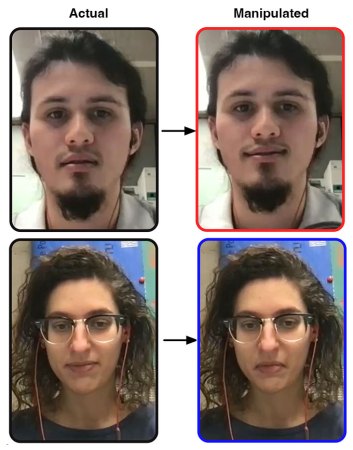
A computer program subtly increased (top example) or decreased (bottom example) people’s smiles as they chatted. While the participants couldn’t tell the difference, the questionnaires they filled out afterward revealed that the artificial differences had the power to influence how attracted potential suitors were to each other.
Arias-Sarah and colleagues focused on a very subtle change in facial tuning—an increasingly easy change to smiling, expressions that can carry a great deal of social information. “Smiles are among the most emblematic and ubiquitous of human emotional expressions,” says Arias-Sarah, capable of communicating attraction, sincerity, competence, and confidence, perhaps even when forced (SN: 9/2/15).
In the four-minute video chats, the 31 participants either had their smiles slightly raised or lowered. For some of the conversations, both people’s smiles increased or decreased similarly. In others, the smiles were wrong, with one person’s smile facing up and the other facing down.
Timing was everything, it turns out. When two conversationalists increased their smiles, they reported higher levels of attractiveness than in other conditions, questionnaires after their conversation revealed. “Romantic attraction was affected by whether the participants were perceiving each other as smiling at the same time,” rather than just being attracted to the other person’s smile, says Arias-Sarah.
Showing that artificially enhanced smiles can affect romantic feelings raises broad questions about the ethical use of face-altering technology. After the speed dating experiment, the volunteers were told that their faces had been manipulated. But as this kind of technology permeates the digital world, these discoveries may not be so forthcoming.
Next, the researchers want to explore other digital transformations, changing gender, expressiveness, gaze or age, to study how they affect social interactions, such as job interviews.
The first glimpse of starlight from a galaxy hosting one of the most distant quasars known has revealed an astronomical wonder.
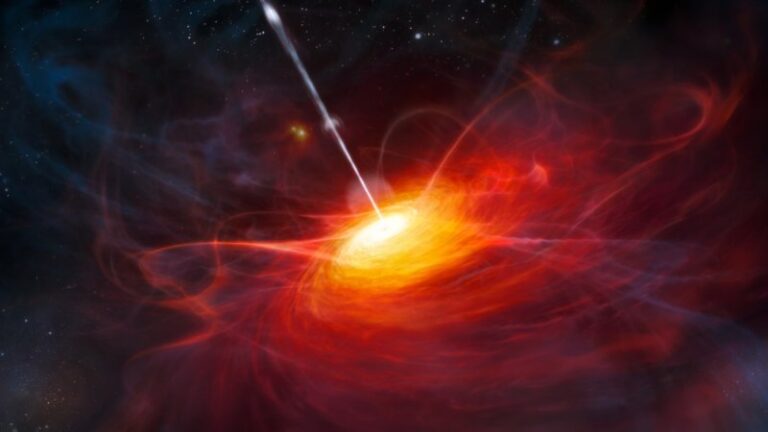
Quasars – extremely bright galactic nuclei – owe their brightness to the intense heat that results when gas swirls around a supermassive black hole. The black hole powering a quasar 13 billion light-years from Earth is half as massive as all the stars around it — a record high ratio for a quasar host galaxy, astronomers report in a paper submitted Oct. 14 to arXiv.org .
All previous attempts to view the host galaxy with the Hubble Space Telescope have failed. So astronomers scored with the James Webb Space Telescope, or JWST, instead (SN: 20/6/23).
The quasar, named ULAS J1120+0641 and the fourth most distant known, passes its galaxy by more than 100 times (SN: 6/29/11). “This makes it very difficult to measure [light] from the host galaxy,” says team member Minghao Yue, an astronomer at MIT. But over the 13 billion years that the quasar’s light has been speeding toward us, the expansion of the universe has stretched the light’s wavelengths by more than 700 percent. Thus, we see the quasar’s visible light at infrared wavelengths, where JWST conducts most of its observations.
The black hole powering the quasar, astronomers find, is 1.4 billion times more massive than the sun, consistent with previous estimates. What is new is the discovery of the host galaxy, whose stars contain up to 2.6 billion solar masses. This is small compared to the Milky Way, whose stellar mass is about 60 billion solar masses. But by the time we see the quasar, about 750 million years after the Big Bang, all galaxies were young, and even most of the largest galaxies had fewer stars than modern star-like giants.
What really sticks out is the black hole’s relative weight: It weighs in at 54 percent of its galaxy’s stellar mass, compared to only about 0.1 percent for the central black holes in modern giant galaxies. “This means that the co-evolution between black holes and their hosts in the early universe must be very different” from modern galaxies, Yue says.
Harvard University astronomer Avi Loeb agrees. He thinks that the quasar’s radiation suppressed star formation in the host galaxy by heating its gas (SN: 16.8.24). To collapse and form stars, the interstellar gas must be cold; otherwise, the outward push of thermal pressure prevents the gas from collapsing into new stars. “If I had to guess,” he says, “the gas isn’t cold enough to make many stars.”
The quasar will be turned off in its future, Loeb says. Then the gas in the surrounding galaxy can cool and form stars, increasing the galaxy’s stellar mass. If we were to see the galaxy as it is today, its black hole mass relative to its stellar mass might very well match that of the giant galaxies near us.
Unfortunately, Yue says, the new work doesn’t address the mystery of how these supermassive black holes grew so quickly after the Big Bang (SN: 18/1/21). But observations show that another galaxy is colliding with the one waiting for the quasar. The collision probably pours gas into the black hole, increasing its already considerable mass and also igniting the quasar so that astronomers can see it at such a great distance.
The biggest conundrum in cosmology may be closer to being solved, thanks to the James Webb Space Telescope.
Scientists disagree on the expansion rate of the universe, known as the Hubble constant. There are two main methods for measuring it – one based on exploding stars called supernovae and the other on the universe’s oldest light, the cosmic microwave background. The two techniques have been in conflict for a decade, in what is known as the “Hubble tension” (SN: 21.3.14). If this tension is real and not the result of an error in one of the measurements, it would require a drastic change in the way scientists understand the universe.
New papers published by two of the central players are raising hopes that additional observations by the James Webb Space Telescope, or JWST, of several types of stars and supernovae could settle the question of whether the discrepancy is real, once and for all.
The two teams disagree on whether that tension exists at all. One team says there is no strong evidence for Hubble tension from JWST data. But the other group says the JWST data strengthens the case that the two types of measurements are in conflict. “I’m even more intrigued by the Hubble tension,” says cosmologist Adam Riess of Johns Hopkins University, leader of one of the teams.
The different camps are finally seeing eye to eye on one part of their measurements: the distances to nearby galaxies, which are needed to infer the expansion rate of the universe from supernovae. “This is really new—we’re agreeing on distances, and that’s a real breakthrough,” says cosmologist Wendy Freedman of the University of Chicago, who leads the other team.
“If you had told me 10 years ago that this would all be agreed at this level, I would have just jumped up and down,” says cosmologist Daniel Scolnic of Duke University, a member of Riess’s team.
This agreement gives scientists new confidence that the long-standing dispute is close to being resolved. “I’m very optimistic that in the next couple of years, the questions we’re talking about now, we’ll have solved them,” Freedman says.
Reaching consensus on distances
Scientists’ theory of the universe, called the standard cosmological model, is based largely on unknowns. Dark matter, a substance that adds invisible mass to galaxies, has never been directly detected. And dark energy, a phenomenon that causes the universe’s expansion to accelerate, is also a total question mark. But the model has proved remarkably successful in describing the cosmos.
Starting from the ancient light of the cosmic microwave background, scientists can use the standard cosmological model to determine today’s rate of expansion. This technique reveals that space is expanding at 67 kilometers per second per megaparsec. (A megaparsec is about 3 million light years.)
But supernova measurements by Riess and colleagues peg the number at about 73 km/s/Mpc – putting the two results in direct conflict. This may hint that something is wrong with the standard cosmological model.
To determine the rate of expansion through the supernova technique, cosmologists must measure the distances to many distant supernovae. This requires a technique called a distance scale, to translate close distances to farther ones.
Under special scrutiny is the second rung of this scale, in which scientists observe certain types of stars – most commonly, pulsating stars called Cepheids – to determine the distances to the galaxies where they reside, as well as to the supernovae that occurred in them the same galaxies. Observing these stars with JWST, which has better resolution than the Hubble Space Telescope, could highlight flaws in measurements on that scale.
In addition to Cepheids, Freedman and colleagues used two other types of stars for their distance measurements. Using JWST data for all three, Freedman and colleagues find an expansion rate of about 70 km/s/Mpc. Given the uncertainties in the measurements, this is close enough to the cosmic microwave background number that it does not require physicists to rethink the cosmos, the team reports in a paper submitted Aug. 12 to arXiv.org. But it also does not completely rule out the existence of the Hubble voltage. “We need more data to answer the question definitively,” says Freedman.
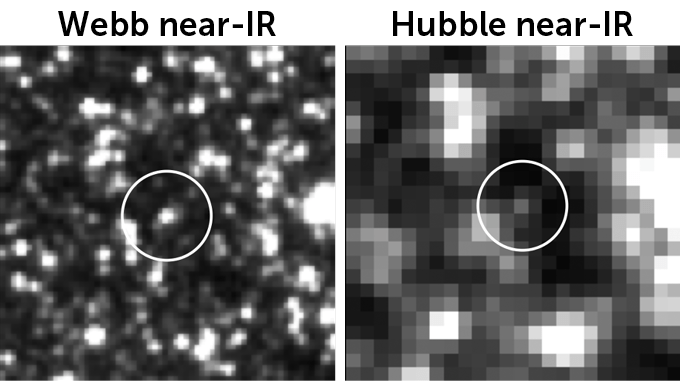
A Cepheid variable star used to measure cosmic distance is shown photographed by both the James Webb Space Telescope (left) and the Hubble Space Telescope (right), at near-infrared wavelengths. The level of detail captured by JWST allows scientists to make more precise measurements of space objects.NASA, ESA, CSA, STScI, AG Riess/JHU, and STScIA Cepheid variable star used to measure cosmic distance is shown photographed by both the James Webb Space Telescope (left) and the Hubble Space Telescope (right), at near-infrared wavelengths. The level of detail captured by JWST allows scientists to make more precise measurements of space objects.NASA, ESA, CSA, STScI, AG Riess/JHU, and STScI
The three distance measurement techniques were generally in agreement, Freedman says. The Cepheid measurements result in a slightly higher value of the Hubble constant than the other two methods, but not enough to indicate anything wrong with the technique. “There’s a trade-off, but the uncertainties are big enough that you can’t say for sure, ‘This is the way it’s going to turn out,'” Freedman says.
Hubble constant
Despite agreeing on the distances, the teams still differ on Hubble’s constant. This may be due to the small number of measurements made with JWST so far, Riess, Scolnic and colleagues report in a paper submitted to arXiv.org on August 21. If Freedman’s team had chosen different galaxies to observe with JWST, they would have obtained a larger value of the Hubble constant, the team argues. (Neither paper has been peer-reviewed, and results may change under further review.)
Scientists are working only with the first data sets from JWST. To solve the puzzle, “the best thing we can do is use much more JWST time to study the distance scale,” says astronomer John Blakeslee of NOIRLab in Tucson, Ariz., who was not involved in the research. .
Freedman wants to continue looking for unidentified issues known as systematic uncertainties that could artificially push estimates of the Hubble constant higher. One concern is clumping—too many stars clumped together in the same place, throwing off Cepheid measurements. Last year, Riess’ team found no evidence of clumping in the JWST data (SN: 28/9/23). But this effect may be more apparent at greater distances than has been studied so far with JWST, Freedman suggests.
If scientists find that different distance measurements disagree, says cosmologist Saul Perlmutter of the University of California, Berkeley, who was not involved in the research, “then it may suggest that we still have to get to the bottom of the systematic uncertainties first.” before we get to a major problem with the cosmological model.”
But many physicists are satisfied with the Hubble tension. First, various other methods have also found higher-than-expected expansion rates, says cosmologist Eleonora Di Valentino of the University of Sheffield in England, who was not involved in the research. “The Hubble tension is still very strong.”
“I see these results as supporting … the fact that we have this difference between what we expect from our standard cosmological model and what we see from these measurements,” says cosmologist Lloyd Knox of the University of California, Davis, who was not involved. in each team.
The standard cosmological model, he notes, relies on mysterious dark energy and dark matter. “Maybe this is a clue to the dark universe and we just have to figure out how to interpret it.”
Scientific watchmakers have created a prototype of a nuclear clock, hinting at future possibilities for using atomic nuclei to make precise time measurements and make new tests of fundamental theories of physics.
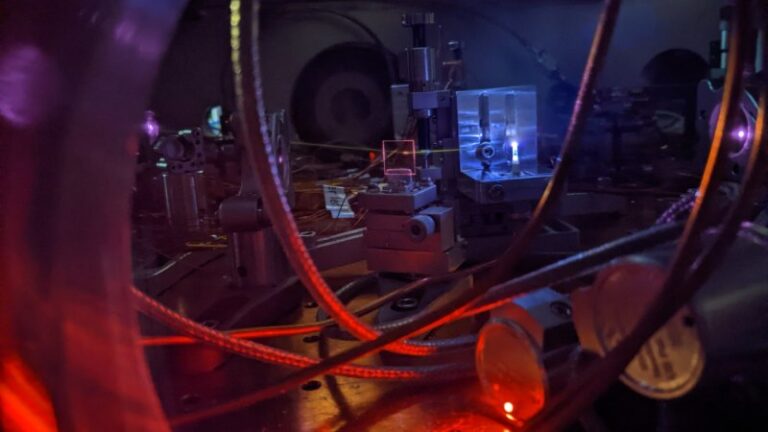
While the definition of “watch” is scientifically nebulous, the prototype has yet to be used to measure time. So it should technically be called the “frequency standard,” says physicist Jun Ye. But the work brings scientists closer to a nuclear clock than ever before. “For the first time, all the essential ingredients for a working nuclear clock are contained in this work,” says Ye, of JILA in Boulder, Colo.
While atomic clocks measure time based on electrons bouncing between energy levels in atoms, nuclear clocks measure time based on the energy levels of atomic nuclei. A certain frequency of laser light is needed for an atom or an atomic nucleus to make such a jump. The electromagnetic wave motion of that light can be used to tell time.
Nuclear clocks would keep time using a variety of the element thorium, called thorium-229. Most atomic nuclei make energy jumps that are too large to be triggered by a tabletop laser. But thorium-229 has two energy levels that are close enough to each other that the transition between these two levels can serve as a clock.
Now, researchers have pinpointed the frequency of light needed to initiate that jump. It’s 2,020,407,384,335 kilohertz, Ye and colleagues report on Sept. 5. Nature.
Most importantly, measurementhas an uncertainty of 2 kilohertz. This is more than a million times the accuracy of the previous best measurement. And it’s more than a billion times the accuracy with which this frequency was known just over a year ago, highlighting multiple successive developments.
The enhancement depends on a component called a frequency comb (SN: 10/5/18). An essential component of many atomic clocks, a frequency comb creates a series of discrete frequencies of light. The use of a thorium-229 frequency comb has been a major research goal for some scientists (SN: 6/4/21). In the new work, Ye and colleagues compared the ticking of the nuclear clock with that of an atomic clock of a known frequency.
“This is something that will be important as a scientific application for tests of fundamental physics,” says physicist Ekkehard Peik of the National Institute of Metrology in Braunschweig, Germany, who was not involved in the new research.
In the future, such comparisons can be used to search for strange physical effects, such as shifting values of fundamental constants (SN: 11/2/16). These are numbers that – as the name implies – are believed to be eternally fixed.
For the first time, astronomers have seen gas boiling and bubbling on the surface of a distant star.
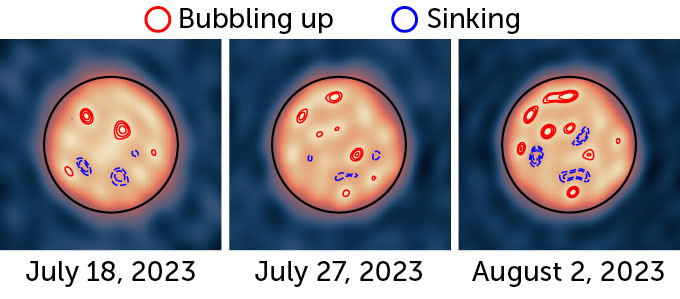
Scientists observed the red giant star R Doradus with the Atacama Large Millimeter/submillimeter Array, or ALMA, in Chile over four weeks in July and August 2023. The series of images show large cells of gas rising to the star’s surface and sinking back down, the team reports IN Nature September 11.
These bubbles are the hallmark of convection, the process that transports heat and energy around the interior of stars. “It’s kind of the principle of a lava lamp or boiling water,” says astronomer Wouter Vlemmings of Chalmers University of Technology in Gothenburg, Sweden.
Similar bubbles have been seen in other giant stars. But this is the first time the speed and motions of the bubbles have been tracked in a star other than the sun.
This diagram shows the sizes and locations of bubbles on the surface of R Doradus, as seen by ALMA over a period of several weeks. The solid red lines represent bubbles rising to the surface, and the dashed blue lines represent bubbles falling into the star towards its core.W. Vlemmings et al/Nature 2024This diagram shows the sizes and locations of bubbles on the surface of R Doradus, as seen by ALMA over a period of several weeks. The solid red lines represent bubbles rising to the surface, and the dashed blue lines represent bubbles falling into the star towards its core.W. Vlemmings et al/Nature 2024
R Doradus is about 180 light years from Earth and is nearing the end of its life (SN: 7/23/21). As part of its dying process, it has inflated to about 350 times the width of the sun, although the two stars are roughly the same mass.
Convective cells on the surface of the star are correspondingly large. A single cell stretches 75 times the width of the sun. The cells rise and fall inside the star at about 20 kilometers per second, about 60 times the speed of sound. That’s faster than astronomers expected based on how convection works in the Sun, and fast enough that a tiny fraction of the gas could escape into space. (SN: 12/5/13).
These observations and others like them could help shed light on the origins of the elements that make up stars, planets and humans. (SN: 11/29/20). Most of the stardust that goes into new objects “comes from stars like the one we saw,” says Vlemmings. “But the process of how this works is still not fully understood. We would like to know the physics, the details of how this works.”